

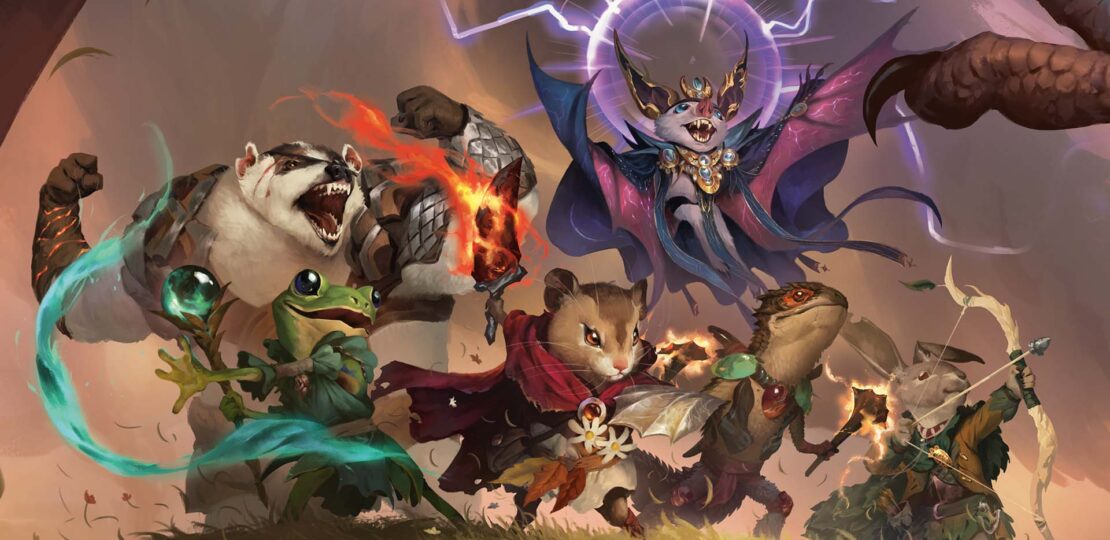
Cover Photo Art (https://magic.wizards.com/en/news/announcements/a-first-look-at-bloomburrow)
When I was spinning up a new campaign for my group, I had recently played in a game with an emphasis on exploration, which inspired me to expand on the “Exploration” pillar of D&D. I also became obsessed with the idea of a world where animal characters went on adventures after the release of the Bloomburrow MTG set and took inspiration from Redwall.
I’ve been playing D&D for about 4-5 years now, and my normal campaigns often involve the expediency of travel for the sake of the story. I’m usually happy to have the party fast-travel days, weeks, or even months to get to the next plot point. But I’ve found a few major downsides to this approach:
- Compressed Timelines: Campaigns that take years to play can take place in only a couple of in-game months.
- Forced Character Arcs: It can force characters to change their feelings toward one another in ways that don’t feel natural. When you fast-track weeks at a time, you’re losing hundreds of hours of potential day-to-day interactions and roleplay.
- The “5-Minute Workday”: It makes balancing encounters difficult. This is a common DM problem. When players know a Long Rest is always just one sleep away, they’ll often blow all their resources in a single fight, trivializing the challenge.
These are issues that I found are almost entirely fixed by a campaign focused on exploration.
The pitch for this new campaign was a low-fantasy, survival game with an emphasis on exploration. I wanted a campaign with internal, ideological, and intimate threats, not world-ending apocalypses. The rot would come from within. This world became known as Morvania.
To achieve this, I built the entire campaign on one core mechanic: Gritty Realism.
Gritty Realism and the 1-Week Long Rest
I knew I wanted to run the campaign using the Gritty Realism rules from the Dungeon Master’s Guide. For us, this means a short rest is 8 hours and a long rest requires one full week of downtime in a safe place.
I established early on that towns were safe, but this could also be a bastion or fortification if the party had allies there.
By running these rules, I was immediately able to build the aesthetic of a world that is less about big, heroic battles and more about the adventure between them. A 3-day journey suddenly becomes a massive risk because you must reach another settlement to recover.
The 3-Day Fetch Quest
This new dynamic became apparent in the very first quest. The local miller needed Ironwood to repair his mill, and the closest source was a forest 3 days away.
I use a 6-mile hex map, and the party could travel 4 hexes per day at a normal pace. This meant a 12-hex journey. I broke each day into morning and afternoon travel, rolling for an encounter in each block. This meant 6 possible encounters on the way to the forest, the encounter at the destination, and 6 more possible encounters on the way back. I could write a whole lot more on how the 6-mile hex changed my perspective for how worlds exist, and I will more than likely do so.
By day 2, the party had already expended most of their hit dice and a large portion of their spell slots.
It was a huge success for the system. I got to see my players being forced to make real, tough decisions about their resources. They weren’t just burning all of their high level spell slots every fight; they were carefully considering every Shield spell and every Cure Wounds.
The Dungeon Detour
The most glaring example of this system’s success was when the party stumbled upon their first dungeon. They still had 9 days of travel left to reach the next town, but they decided to explore it anyway.
The dungeon resulted in a near-TPK. It forced them to use all of their resources they had left. But the reward was huge: multiple magic items, several hundred gold, and a ton of experience.
This created the single best moment of player choice I’ve seen in a long time. They were now faced with a decision:
- Risk continuing their 9-day journey to the next town with almost no resources.
- Turn back to the town they just left, take a week-long rest, sell their loot, and start the journey over.
They decided to risk it.
The next 9 days of in-game travel were an incredibly nerve-wracking experience for the whole table as they limped along, dodging hungry ratfolk, boars riding other boars, and the terrifying “Gloom.” They ultimately made it to their destination, but literally by the skin of their teeth.
Building a World to Match the Rules
Once the Gritty Realism engine was in place, I built a world that felt consistent with it.
1. Low Magic, High Stakes
I wanted magic to feel powerful and rare. I broke it down into three categories:
- Primal Magic: The most common and accepted form. Less “magic” and more a deep understanding of the natural world.
- Divine Magic: Uncommon but respected. Power drawn from localized ideals and spirits, not distant gods.
- Arcane Magic: Rare, mysterious, and feared.
This wasn’t to stop my players from choosing full-caster classes. In fact, my initial party was almost entirely full casters. This created a wonderful moment to explain that the “low magic” of the world didn’t apply to them; it meant they were the exceptions.
But it also meant that any enemy they came across who also had access to magic would be just as special, dangerous, and terrifying as they were.
2. An Aesthetic of Scale
I loved the idea of a world that was not built for the characters. The setting is a world of giants that have long since disappeared, and all that is left is what they left behind.
These giants have left countless artifacts laying around. Legends have been born from brave woodland critters (my players’ races) forging weapons and armor from these scraps and taking up arms in the name of glory and heroism. This “tiny heroes in a giant’s world” aesthetic constantly emphasizes the scale and danger, reinforcing the gritty, survivalist tone that I am going for.
By combining the Gritty Realism rest rules with a world built to support them, “exploration” has become the most exciting part of our game, and the simplest journey has become a genuine adventure.
3. Character Decisions Drives the Game
As always, the Characters are the most important aspect of the world. This is always important in a D&D game, however, I feel that it is even more important in a campaign that utilizes the Gritty Realism rules. Suddenly, the party needs to determine if the mundane items that they purchase can replace the uses that spell slots usually fill. My players have, and spend a lot of time discussing as a group what they’re interested in purchasing or looking for, and as the Dungeon Master, I’m just making notes to incldue it in the loot pool.
RELATED POSTS
View all


